¶ 🚀 Cybernode Preferred Server Selection
Welcome to the gateway of enhanced performance. This guide helps you elevate your Exium SASE experience by strategically choosing the Preferred Server — the SASE cloud node, or Cybernode — closest to your users and connecting locations within the CyberMesh.
TL;DR — Closer Cybernode = lower latency + higher throughput. When in doubt, run a quick speed test to the nearest few nodes and let the numbers decide.
¶ 🌐 Exium's CyberMesh
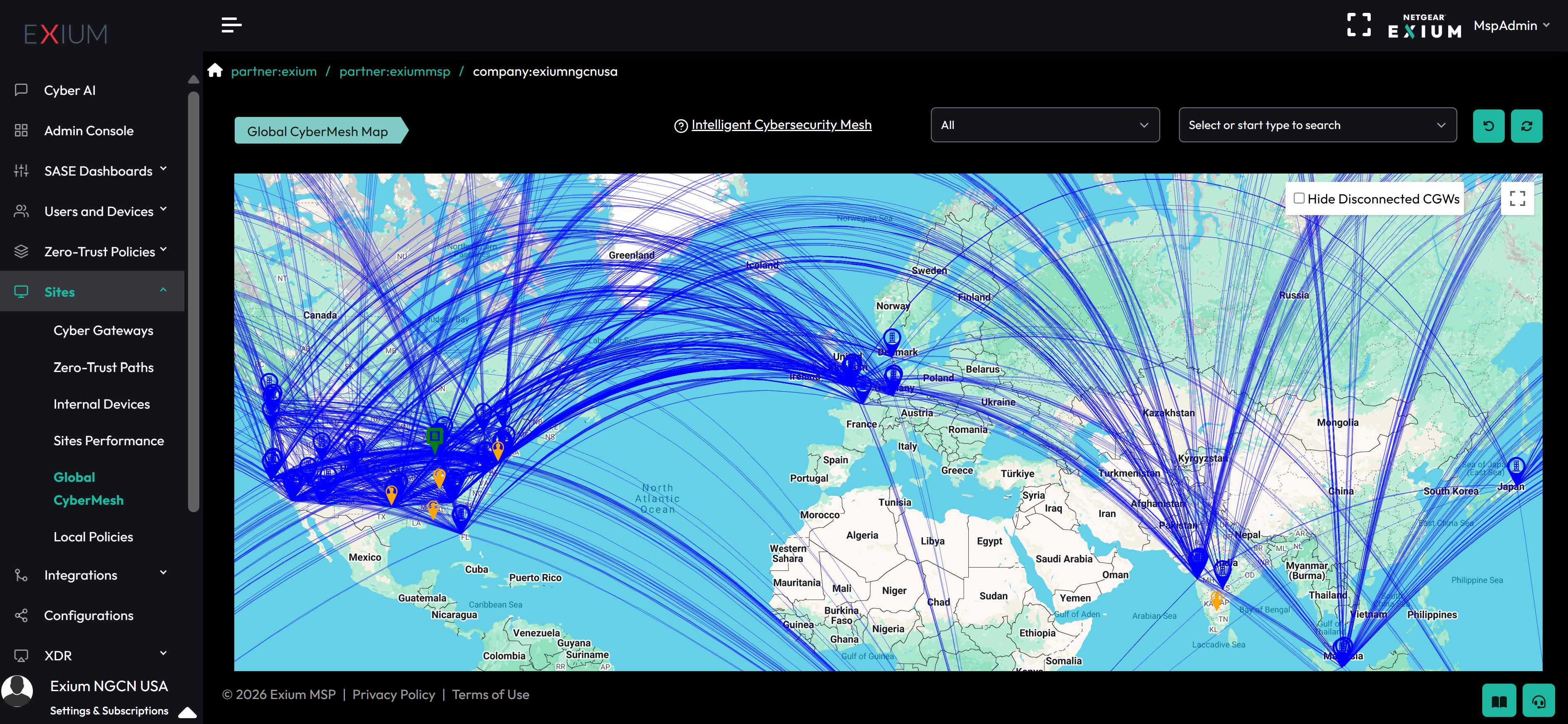
Step into the future with Exium's Intelligent Cybersecurity Mesh — a cloud-scale security platform that seamlessly connects and safeguards your apps, data, devices, and users on a global scale, all built on a foundation of Zero Trust.
¶ ⚡ Latency & Throughput Tests
When creating a workspace for your client organization, the key decision is selecting the Preferred Server in Exium's portal. Optimal performance comes from choosing the server closest to your users and connecting locations — this guarantees lower latency and higher throughput.[1]
If the choice isn't obvious, run throughput and latency tests directly to our CyberMesh from the devices and locations you intend to secure.
Before testing, turn off any VPN or proxy — they can skew the results and lead to the wrong server selection.
Latency and throughput vary with the time of day and network conditions. Treat these tests as a guiding light, weighed alongside the geographic proximity of the Preferred Server, to make a well-informed choice.
| Cybernode | Latency & Throughput Test |
|---|---|
| Ashburn, Virginia | http://172.111.38.5:3000/ |
| Atlanta, Georgia | http://23.92.73.35:3000/ |
| Chicago, Illinois | http://64.29.176.240:3000/ |
| Dallas, Texas | http://64.29.177.240:3000/ |
| Denver, Colorado | http://170.101.100.184:3000/ |
| Detroit, Michigan | http://64.29.176.240:3000/ |
| Las Vegas, Nevada | http://76.164.192.194:3000/ |
| Los Angeles, California | http://64.29.179.240:3000/ |
| New York, New York | http://64.29.178.240:3000/ http://23.227.200.229:3000/ |
| Phoenix, Arizona | http://23.158.200.249:3000/ |
| Portland, Oregon | http://208.115.255.70:3000/ |
| Salt Lake City, Utah | http://173.231.10.174:3000/ |
| San Francisco, California | http://23.157.40.110:3000/ |
| Seattle, Washington | http://91.191.218.46:3000/ |
| Tampa, Florida | http://209.133.195.194:3000/ |
| Cybernode | Latency & Throughput Test |
|---|---|
| Montreal, Quebec | http://23.162.56.32:3000/ |
| Toronto, Ontario | http://67.220.94.217:3000/ |
| Vancouver, British Columbia | http://158.51.123.45:3000/ |
| Cybernode | Latency & Throughput Test |
|---|---|
| Dubai, United Arab Emirates | http://139.185.34.199:3000/ |
| Dublin, Ireland | http://3.255.1.35:3000/ |
| Frankfurt, Germany | http://66.206.24.110:3000/ |
| Johannesburg, South Africa | http://129.151.186.125:3000/ |
| London , England | http://64.29.181.240:3000/ |
| Paris, France | http://45.128.134.214:3000/ |
| Milan, Italy | http://45.128.134.214:3000/ |
| Cybernode | Latency & Throughput Test |
|---|---|
| Hyderabad, India | http://144.24.144.34:3000/ |
| Mumbai, India | http://64.29.182.240:3000/ |
| Chennai, India | http://64.29.182.240:3000/ |
| Singapore | http://107.155.95.30:3000/ |
| Sydney, Australia | http://217.79.246.67:3000/ |
| Taipei, Taiwan | http://43.213.160.124:3000/ |
| Tokyo, Japan | http://181.41.140.94:3000/ |
Pick your region, locate the Cybernode nearest you, and open its endpoint to launch the test. Endpoints now use direct IP addresses for the speed-test servers.
¶ 🛡️ Failover & High Availability
In every region listed above, Exium operates multiple Cybernodes to accommodate capacity demand, enable seamless failover, and deliver high availability — so your users stay protected and performant even if a single node is taken out of rotation.
¶ 🔐 Secure Private Access (SPA) Tests
You can benchmark Secure Private Access (SPA) latency and performance with a simple test against the speed-test server running on the internal network inside the Cyber gateways.
For the SPA test to work, you must be connected to Exium — either with the Exium client running on your device, or from a location secured by Exium's Cyber gateway.
Steps:
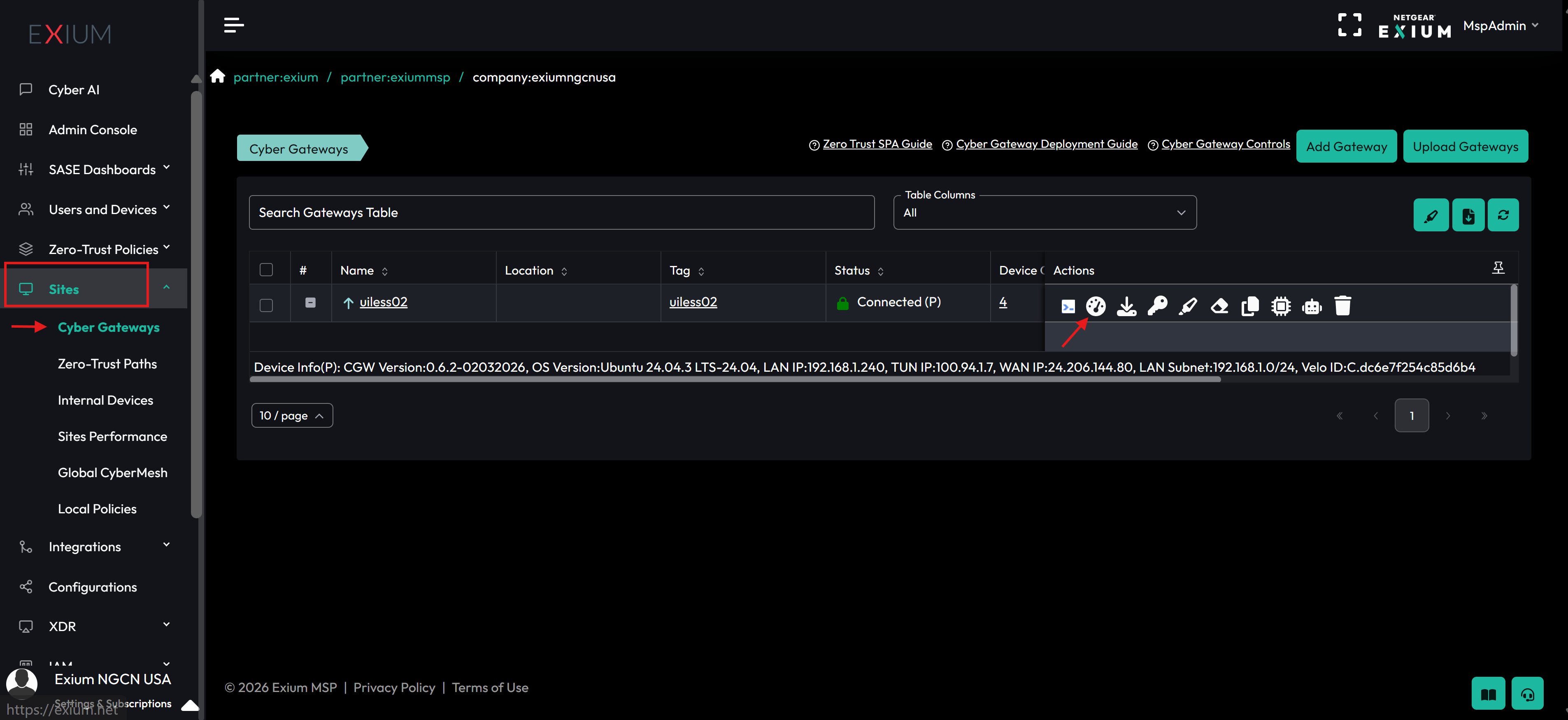
- Navigate to the MSP admin console → Client Workspace.
- In the left menu bar, click Sites → Cyber Gateways.
- Click the Speedtest icon (shown below) to launch the latency, jitter, and throughput tests.
¶ 📬 Talk to Us
Want to learn more about implementing SASE for your organization and explore tailored solutions for your unique requirements?
Contact Exium at hello@exium.net for a consultation or demonstration.
Results reflect the path from your test device to the speed-test server running inside the chosen Cyber gateway. Re-run the test a few times to smooth out transient network noise. ↩︎